Calibration
Radio Filter
- LF-RF-1 Weak Filter, Strong Resistance ( > 1500 \(\Omega\) )
- LF-RF-2 Strong Filter, Weak Resistance ( < 1500 \(\Omega\) )
for ADU-10e and ADU-11e. For older systems it is more complicated.
ADU-08e
HF Board 08e
The theoretical transfer function for the HF-channel is given below:
\(F_{HF - Channel} = G_{1} \cdot F_{1} \cdot F_{2} \cdot F_{3} \cdot F_{4}\)
with
\(G_{1} = 1 \ or\ 4, 8, 16\) depending on gain setting of first stage
\(F_{1} = \frac{1}{1 + P_{1}}\); \(P_{1} = i \cdot \frac{f}{338 kHz}\)
\(F_{2} = \frac{1}{1 + P_{2}}\); \(P_{2} = i \cdot \frac{f \cdot G_{1} }{100 MHz}\)
\(F_{3} = \frac{1}{1 + P_{3}}\); \(P_{3} = i \cdot \frac{f}{1.59 MHz}\)
\(F_{4} = \frac{P_{4}}{1 + P_{4}}\); \(P_{4} = i\frac{f}{482 Hz}\) if high-pass is switched on.
\(F_{4} = 1\) if high-pass is switched off.
(gains and input divider are calibrated into the LSB, you don’t see them)
LF Board 08e
\(F_{LF - Channel} = G_{1} \cdot G_{2} (\cdot G_{3}) \cdot F_{1} \cdot F_{2} \cdot F_{3} \cdot F_{4}\)
\(G_{1} = 1 \ or\ 4, 8, 16\) depending on gain stage 1 settings
\(G_{2} = 1 \ or\ 4, 8, 16, 32, 64\) depending on gain stage 2 settings, inside the ADC; (32, 64 not set by software, only manually)
Gains and input divider do not appear in the ats file, they are calibrated into the LSB
\(G_{3} = 2\) is a fixed gain and can’t be changed; this gain is invisible in the time series
\(F_{1} = \frac{1}{1 + P_{1}}\); \(P_{1} = i\frac{f}{318 kHz}\)
\(F_{2} = \frac{1}{1 + P_{2}}\); \(P_{2} = i\frac{f \cdot G_1 }{2 MHz}\)
\(F_{3} = \frac{1}{1 + 1.414 \cdot P_{3} + P_{3}^{2}}\); \(P_{3} = i \cdot \frac{f}{4Hz}\) if 4 Hz Low-pass is switched on, else 1
and
\(F_{4} = \frac{1}{1 + P_{4}}\); \(P_{4} = i \cdot \frac{f}{10.5 kHz}\) if RF-2 on & DIV-8 = on (default for coil, not used for E)
\(F_{4} = \frac{1}{1 + P_{4}}\); \(P_{4} = i \cdot \frac{f}{30 kHz}\) if RF-1 on & DIV-8 = on (not used for E)
\(F_{4} = \frac{1}{1 + P_{4}}\); \(P_{4} = i \cdot 2 \pi f \cdot (R_{sensor} + 200) \cdot 7.27E^{-9}Hz\) if RF-2 on & DIV-1 = on (default for electrodes < 1500 Ohm contact resistance, default for buffer electrodes, not used for H) )
\(F_{4} = \frac{1}{1 + P_{4}}\); \(P_{4} = i \cdot 2 \pi f \cdot (R_{sensor} + 200) \cdot 470E^{-12}Hz\) if RF-1 on & DIV-1 = on ( electrodes > 1500 Ohm contact resistance, not used for H)
in old manuals the equations were written like
\(P_{4} = i \cdot \frac{f}{\frac{0.159}{(R_{sensor} + 200) \cdot 7.27E^{-9}Hz}}\)
\(P_{4} = i \cdot \frac{f}{\frac{0.159}{(R_{sensor} + 200) \cdot 470E^{-12}Hz}}\)
ADU-10e
LF Board 10e
\(F_{LF - Channel} = [G_{1}] \cdot F_{1} \cdot F_{4}\)
\(G_{1} = 1 \ or\ 4, 8, 16, 32, 64\)
The \(G_{1}\) (inside ADC) is a chopper stabilized gain. The SW shall set 1 as default, for E this means \(\pm\) 2.5 V input range.
Since the gain \(G_{1}\) and the input divider are inside the LSB (ATS format) or included in the mV data stream (ATSS) we neglect the gain.
\(F_{1} = \frac{1}{1 + P_{1}}\); \(P_{1} = i\frac{f}{318 kHz}\)
and
\(F_{4} = \frac{1}{1 + P_{4}}\); \(P_{4} = i \cdot \frac{f}{7.8 kHz}\) if DIV-8 = on (default for coil, not used for E)
\(F_{4} = \frac{1}{1 + P_{4}}\); \(P_{4} = i \cdot 2 \pi f \cdot (R_{sensor} + 200) \cdot 6.8E^{-9}Hz\) if DIV-1 = on (default for electrodes, not used for H) )
(in old manuals the equation was written like \(P_{4} = i \cdot \frac{f}{\frac{0.159}{(R_{sensor} + 200) \cdot 6.8E^{-9}Hz}}\) )
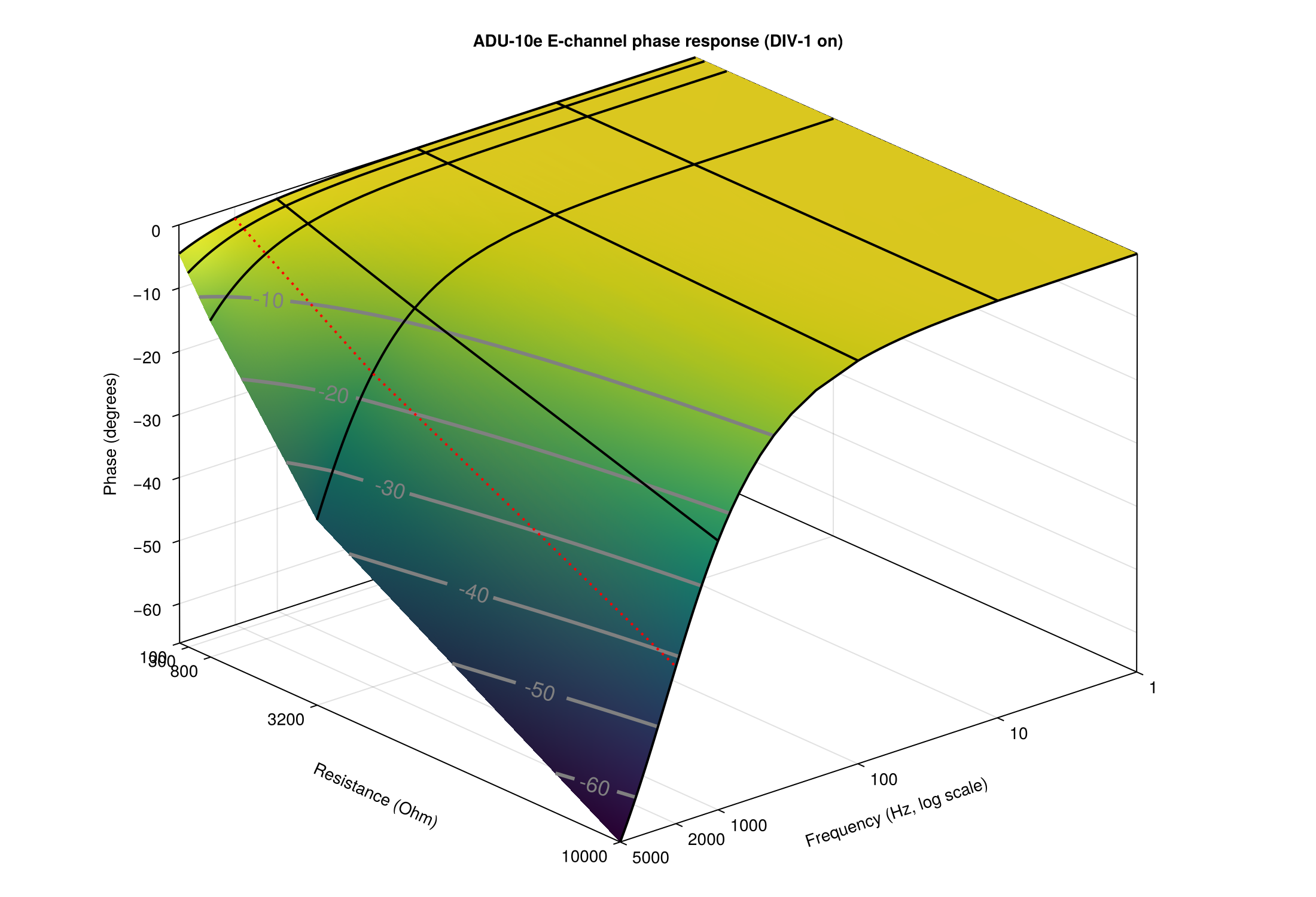
red dotted line 2000 Hz
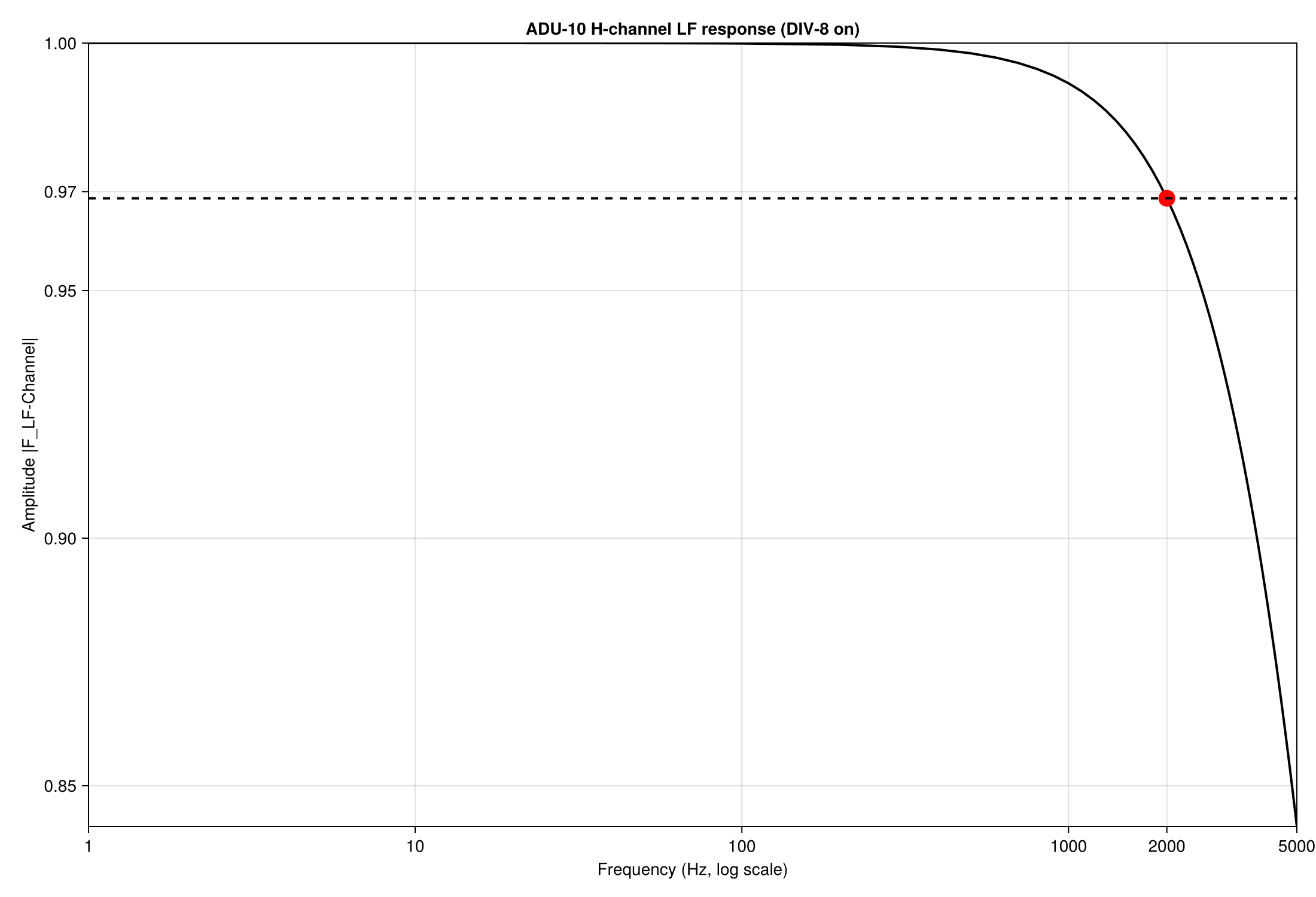
For H up to 2 kHz, the low-pass filter of the board can be considered negligible. The phase becomes almost not negligible.
For E the low-pass filter of the board has a more significant effect for higher frequencies and high resistance surfaces.
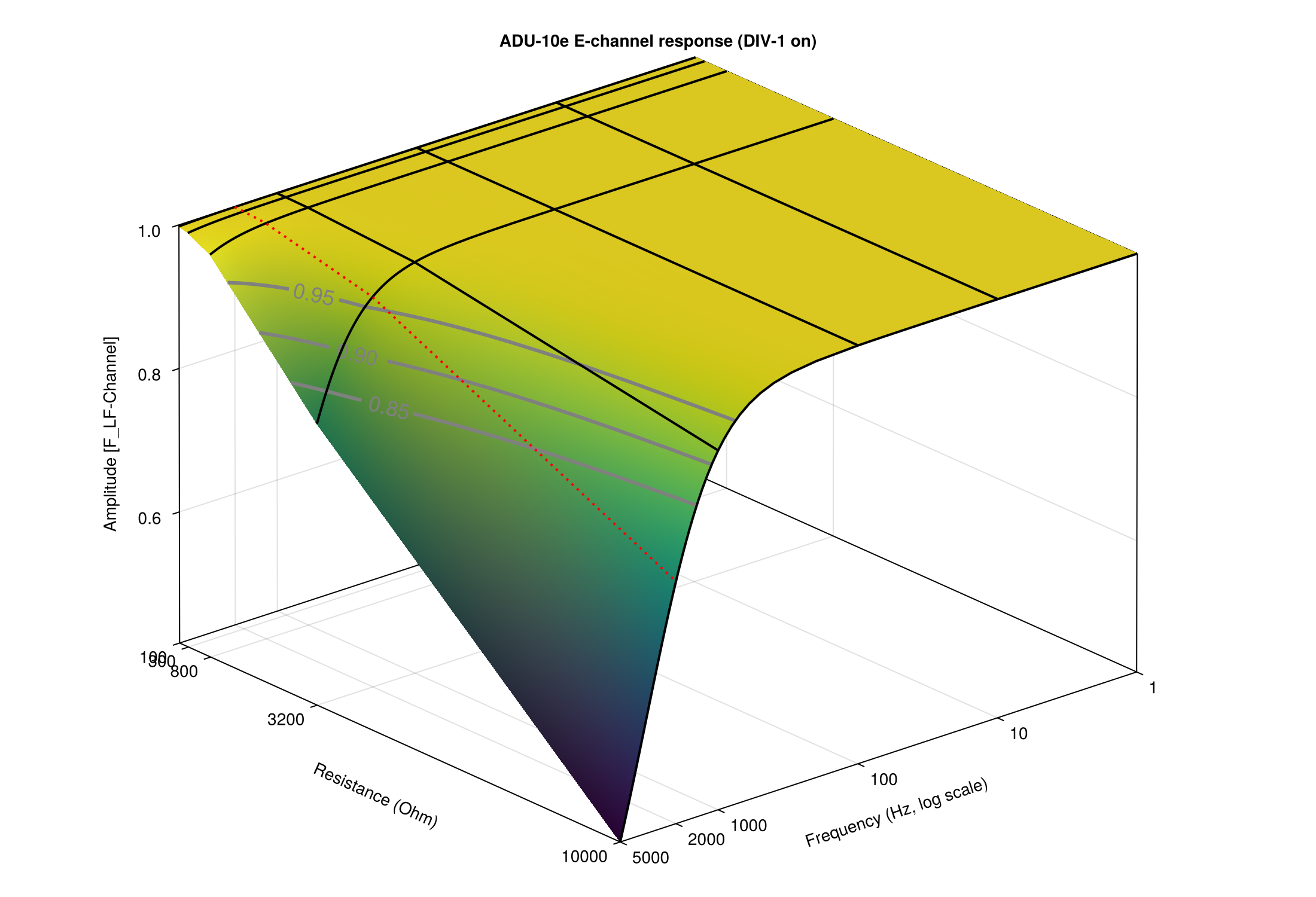
So at 5 k\(\Omega\) and 2000 Hz in the spectra, the decay is 0.9.
ADU-11e
To correct the low pass character of the ADU-11e1, the following transfer functions are used:
Board
The board switches two “Radio Filters” depending on the DIV setting and the type of sensor connected. These filters are denoted as RF1 and RF2 and are used to shape the frequency response of the input signal before it reaches the ADC, in order to protect the ADC from aliasing and to limit high-frequency noise.
The RF1 for H, DIV-8 is always on, even not mentioned explicitly in the binary atsheader.
\(F_{Board} = [G_{2}] \cdot F_{1} \cdot F_{2} = [G_{2}] \cdot \frac{1}{1 + P_{1}} \cdot \frac{1}{1 + P_{2}}\)
\(G_{2} = 1 \ or\ 4, 8, 16, 32, 64\) (G1 was on old boards, not existing here, G2 is inside ADC)
Since the gain \(G_{1}\) and the input divider (1 or 8) are inside the LSB (ATS format) or included in the mV data stream (ATSS) we neglect the gain.
\(F_{1} = \frac{1}{1 + P_{1}}\); \(F_{2} = \frac{1}{1 + P_{2}}\)
\(C_1 = 1 \cdot E^{-9}\)
For H and DIV-8 on, always RF-1 (default for coil, not used for E)
\(P_{1} = i \cdot 2 \pi f \cdot 2200 \cdot 1 \cdot C_1\)
\(P_{2} = i \cdot 2 \pi f \cdot 1100 \cdot 1 \cdot C_1\)
For E and DIV-1 on (default for electrodes, not used for H)
- RF1 (“strong”) \(C_2=1.0 \cdot E^{-10}\) < 5000 Ohm contact resistance, default for buffer electrodes
- RF2 (“weak”) \(C_2=1.1 \cdot E^{-9}\) > 5000 Ohm contact resistance
\(P_{1} = i \cdot 2 \pi f \cdot (R_{sensor} + 2200) \cdot 1 \cdot C_1\)
\(P_{2} = i \cdot 2 \pi f \cdot (\frac{R_{sensor}}{2} + 1100) \cdot C_2\) depending on RF1 or RF2 selection.
ADC
For a simple approximation:
Gaussian low-pass filter is applied to the signal: \[ADC_{Gauss} = e^{-\left(\frac{f}{f_c}\right)^{2}}\]
| sampling rate | cut-off frequency |
|---|---|
| 1024 Hz | 393 Hz |
| 2048 Hz | 786 Hz |
| 4096 Hz | 1570 Hz |
| 8192 Hz | 3140 Hz |
| 16384 Hz | 6261 Hz |
| 32768 Hz | 12370 Hz |
| 65536 Hz | 23600 Hz |
| 131072 Hz | 41000 Hz |
In a plot natural logarithm of the normalized signal lnnormalized versus f² the Gaussian low-pass filter will appear as a straight line with a slope of \(\frac{-1}{f_c²}.\)
With fc = 0.38 * fsampling rate works perfectly up to 32 kHz and even 64 kHz. At 131 kHz the approximation starts to deviate significantly.
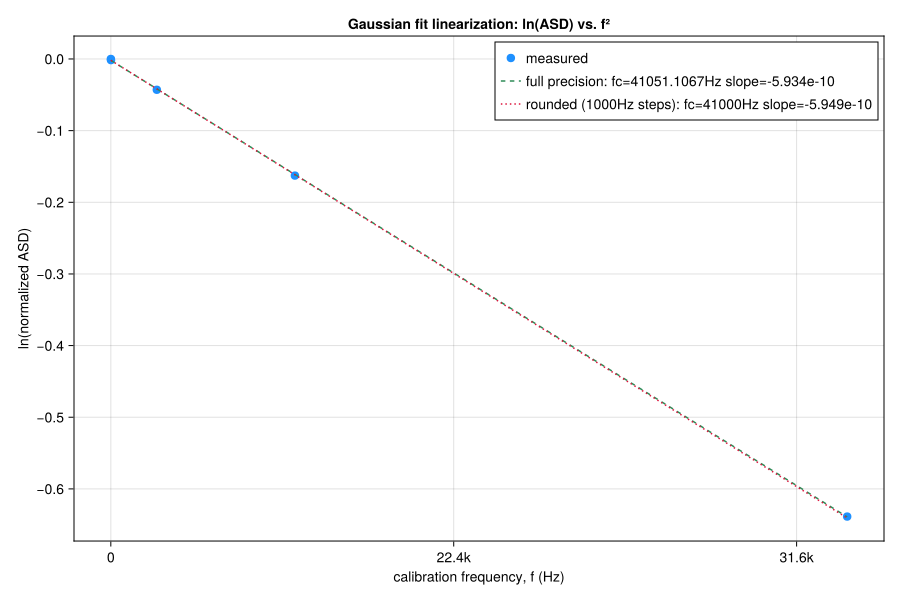
22.4k label is placed at 22.4k² “real world”
For a precise AD approximation:
The SINC calculation uses the following parameters:
- \(f_s = \text{sampling rate} / 1000\): sampling rate in kHz, also known as the output data rate (ODR).
- \(M_{\mathrm{CLK}} = 8388.608\) kHz: master clock frequency.
- \(F_{\mathrm{mod}} = M_{\mathrm{CLK}} / 4\): modulation frequency in kHz for high-resolution mode.
- \(N_{\mathrm{dec}} = F_{\mathrm{mod}} / f_s\): decimation factor, the ratio of modulation frequency to output data rate.
- \(\text{output data rate} = f_s\): output data rate in kHz, rounded to two decimal places in the Excel sheet.
- \(f_{\mathrm{order}} = 5\): order of the AD7771 ADC’s sinc filter, typically sinc5 in high-resolution mode.
- \(n_{\mathrm{fixed}} = 16\): number of fixed points used in the filter. The original comment notes that 128 is typical for the AD7771, but the Excel sheet uses 16 and 128 produces a very large decay.
- \(n_{\mathrm{chop}} = 16\): number of chopped points used in the filter, typically 16 for the AD7771 ADC. This parameter does not appear in the SINC expression below.
- \(f\): frequency in Hz in the spectrum
The calibration amplitude is calculated as
\[ \mathrm{ADC}_{AD} = \left| \left( \frac{1}{\lfloor N_{\mathrm{dec}} \rfloor} \frac{\sin\left(\frac{\lfloor N_{\mathrm{dec}} \rfloor \pi f}{1000 F_{\mathrm{mod}}}\right)} {\sin\left(\frac{\pi f}{1000 F_{\mathrm{mod}}}\right)} \right)^{f_{\mathrm{order}} - 1} \left( \frac{1}{n_{\mathrm{fixed}}} \frac{\sin\left(\frac{n_{\mathrm{fixed}} \pi f}{1000 F_{\mathrm{mod}}}\right)} {\sin\left(\frac{\pi f}{1000 F_{\mathrm{mod}}}\right)} \right) \right| \]
The resulting complex calibration value has this amplitude and zero phase (so no phase shift)
Complete
Use the simple Gauss for fast approximation or the AD (Sinc5) for precise approximation.
\[\begin{aligned} cal &= \mathrm{ADC}_{Gauss} \cdot F_{Board} \\ \text{or} \\ cal &= \mathrm{ADC}_{AD} \cdot F_{Board} \end{aligned}\]
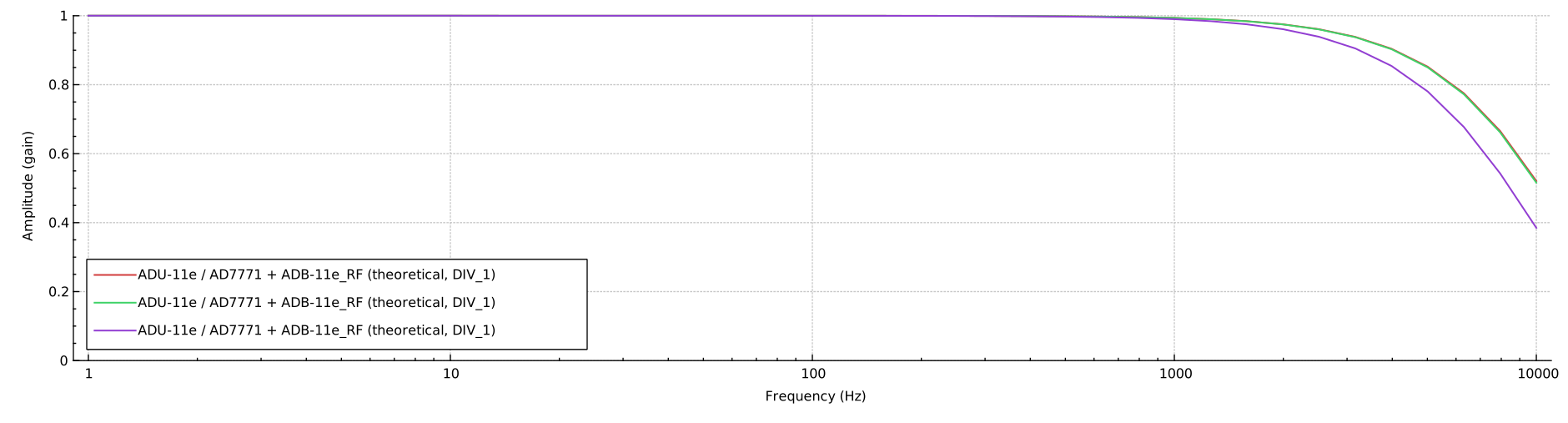
E, 100, 1000, 10000 \(\Omega\) contact resistance
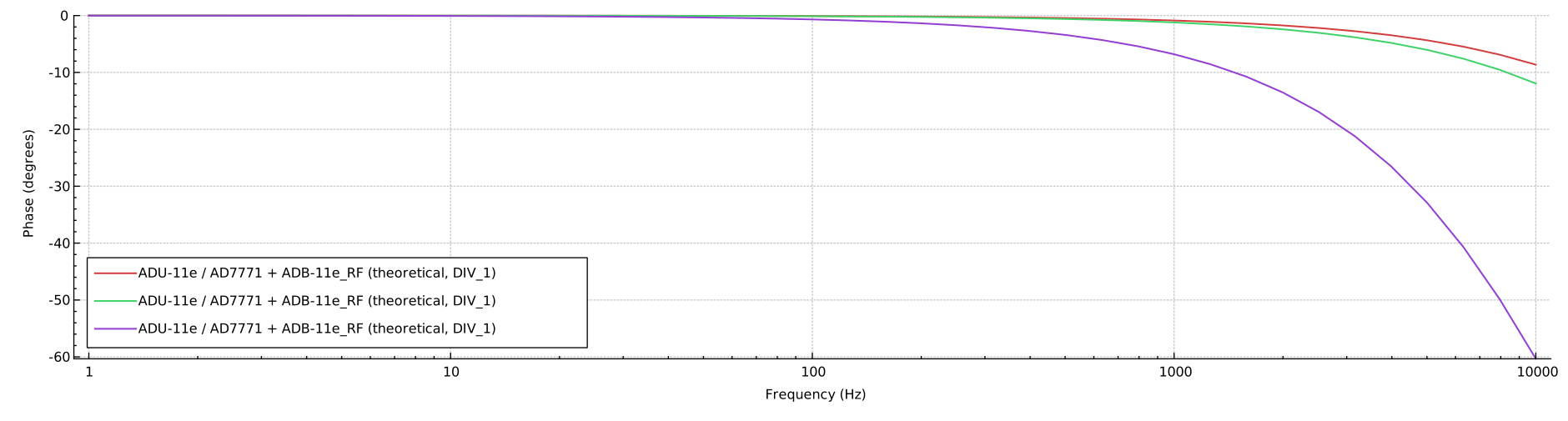
E, 100, 1000, 10000 \(\Omega\) contact resistance
ADU-07e
HF Board 07e
The theoretical transfer function for the HF-channel is given below:
\(F_{HF - Channel} = G_{1} \cdot G_{2} \cdot F_{1} \cdot F_{2} \cdot F_{3}\)
with
\(G_{1} = 1 \ or\ 8\) depending on gain setting of first stage
\(G_{2} = 1 \ or\ 8 \ or\ 64\) depending on gain setting of second stage
\(F_{1} = \frac{1}{1 + P_{1}}\); \(P_{1} = i \cdot \frac{f}{7.23 MHz}\) if \(G_1 \ne 1\)
\(F_{2} = \frac{1}{1 + P_{2}}\); \(P_{2} = i \cdot \frac{f}{7.23 MHz}\) if \(G_2 \ne 1\)
\(F_{3} = \frac{P_{3}}{1 + P_{3}}\); \(P_{4} = i\frac{f}{1 Hz}\) if high-pass is switched on.
(gains and input divider are calibrated into the LSB, you don’t see them)
LF Board 07e
\(F_{LF - Channel} = G_{1} \cdot G_{2} \cdot F_{1} \cdot F_{2} \cdot F_{3} \cdot F_{4}\)
\(G_{1} = 1 \ or\ 2, 4, 8, 16, 32, 64\) depending on gain stage 1 settings
\(G_{2} = 1 \ or\ 2, 4, 8, 16, 32, 64\) depending on gain stage 2 settings, inside the ADC; (32, 64 not set by software, only manually)
\(F_{1} = \frac{1}{1 + P_{1}}\); \(P_{1} = i \cdot \frac{f}{4 kHz}\) // to be checked if \(G_1 \ne 1\)
\(F_{2} = \frac{1}{1 + P_{2}}\); \(P_{2} = i \cdot \frac{f}{21.2 kHz}\) // to be checked
\(F_{3} = \frac{1}{1 + 1.414 \cdot P_{3} + P_{3}^{2}}\); \(P_{3} = i \cdot \frac{f}{4Hz}\) if 4 Hz Low-pass is switched on
\(F_{4} = \frac{1}{1 + P_{4}}\); \(P_{4} = i \cdot 2 \pi f \cdot (R_{sensor} + 200) \cdot 2.2E^{-11}Hz\) if RF-1 on & DIV-1 = on (default for electrodes < 600 Ohm contact resistance not used for H, prefer RF-2) )
\(F_{4} = \frac{1}{1 + P_{4}}\); \(P_{4} = i \cdot 2 \pi f \cdot (R_{sensor} + 200) \cdot 1.22E^{-10}Hz\) if RF-2 on & DIV-1 = on (default for electrodes < 1500 Ohm contact resistance, default for buffer electrodes, not used for H) )
\(F_{4} = \frac{1}{1 + P_{4}}\); \(P_{4} = i \cdot 2 \pi f \cdot (R_{sensor} + 200) \cdot 6.822E^{-9}Hz\) if RF-3 on & DIV-1 = on (default for electrodes 1500-2500 Ohm contact resistance, prefer RF-4 not used for H) )
\(F_{4} = \frac{1}{1 + P_{4}}\); \(P_{4} = i \cdot 2 \pi f \cdot (R_{sensor} + 200) \cdot 6.922E^{-9}Hz\) if RF-4 on & DIV-1 = on (default for electrodes > 1500 Ohm contact resistance) )
// missing DIV-8
MF Board 07e
tbd.
MFS Coils
OLD Calibration Files are normalized by f!
e.g. the MFSXXX.txt files.
The JSON files are using mV (as the time series data) and are not normalized by f.
If you normalize the calibration by frequency you end up with a constant \(\frac{200 mV}{nT \cdot Hz}\) and 90° phase below 0.1 Hz for the MFS-06e and \(\frac{200 mV}{nT \cdot Hz}\) and 90° for the MFS-07e.
The term \(P_{1}\) is the cut-off frequency generated by the feedback coil.
The other terms \(P_{2}\), \(P_{3}\), \(P_{4}\) are result of the pre-amplifier components23.
MFS-06e
\(P_{1} = i \cdot \frac{1}{4 Hz}, \enspace P_{2} = i \cdot \frac{1}{9645 Hz} \enspace\) \(P_{3} = i \cdot \frac{1}{0.72 Hz},\enspace P_{4} = i \cdot \frac{1}{23897 Hz}\)
Chopper on
\(F_{on}(f)\,\left[\frac{mV}{nT}\right] = 800 \cdot \frac{P_1}{1+P_1} \cdot \frac{1}{1+P_2} \cdot \frac{1}{1+P_4}\)
Chopper off
\(F_{off}(f)\,\left[\frac{mV}{nT}\right] = 800 \cdot \frac{P_1}{1+P_1} \cdot \frac{1}{1+P_2} \cdot \frac{P_3}{1+P_3} \cdot \frac{1}{1+P_4}\)
MFS-07e
\(P_{1} = i \cdot \frac{1}{32 Hz}, \enspace P_{2} = i \cdot \frac{1}{45150 Hz} \enspace\)
\(P_{3} = i \cdot \frac{1}{0.72 Hz},\enspace P_{4} = i \cdot \frac{1}{49735 Hz}\)
Chopper on
\(F_{on}(f)\,\left[\frac{mV}{nT}\right] = 640 \cdot \frac{P_1}{1+P_1} \cdot \frac{1}{1+P_2} \cdot \frac{1}{1+P_4}\)
Chopper off
\(F_{off}(f)\,\left[\frac{mV}{nT}\right] = 640 \cdot \frac{P_1}{1+P_1} \cdot \frac{1}{1+P_2} \cdot \frac{P_3}{1+P_3} \cdot \frac{1}{1+P_4}\)
MFS-12e
\(P_{1} = i \cdot \frac{1}{16 Hz}, \enspace P_{2} = i \cdot \frac{1}{9645 Hz} \enspace\) \(\enspace P_{4} = i \cdot \frac{1}{50048 Hz}\)
Switch free
In the old days we used copper on == LF mode and chopper off == HF mode.
Now we have a switch free design, so only one transfer function is used.
However, the amplifier still has a chopper stage, which is always on, but invisible in the transfer function.
The transfer function is a mix of both modes:
\(F(f)\,\left[\frac{mV}{nT}\right] = 800 \cdot \frac{P_1}{1+P_1} \cdot \frac{1}{1+P_2} \cdot \frac{1}{1+P_4}\)
MFS-14e
tdb.
SHFT coils
SHFT-02e
YOU MUST USE THE CALIBRATION FILES FOR THIS SENSOR
SHFT-03e
YOU MUST USE THE CALIBRATION FILES FOR THIS SENSOR
Fluxgates
Fluxgate magnetometers from Bartington Instruments just need to be scaled.
FGS-02e
Fluxgate with 75,000 nT range, Geomag-01.
\(F(f)\,\left[\frac{mV}{nT}\right] = 7.5 \cdot 10^{-1}\)
FGS-03e
Fluxgate with 100,000 nT range, Bartington Mag-03.
\(F(f)\,\left[\frac{mV}{nT}\right] = 1 \cdot 10^{-1}\)
FGS-04e
Fluxgate with 100,000 nT range, Bartington Mag-13 MCL (MC = cylindrical core, L = low noise).
That is a newer version of the FGS-03e, with a better noise performance.
\(F(f)\,\left[\frac{mV}{nT}\right] = 1 \cdot 10^{-1}\)
FGS-05e
Fluxgate with 70,000 nT range, Bartington (never sold)
You may get an out of drift here.
\(F(f)\,\left[\frac{mV}{nT}\right] = 1.43 \cdot 10^{-1}\)